
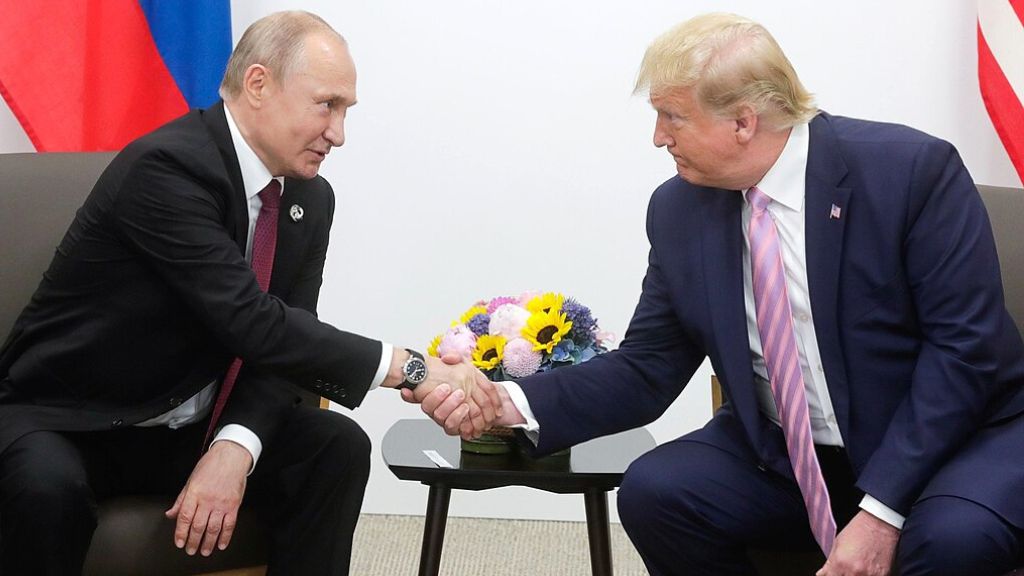
In mid-January of 2026, the American President Donald Trump publicly called on Russian President Vladimir Putin to become part of a recently proposed international peace body in connection with the conflict in Gaza. The invitation was part of a larger effort on the part of the US (and others) to assist in the management of the ceasefire and post-conflict governance in the Gaza Strip. The Kremlin substantiated it received the invitation and was considering it.
The proposed body is referred to by the U.S. officials as a “Board of Peace”. The stated purpose of Hansl is attributed to overseeing the implementation of a ceasefire between Israel and Palestinian armed groups, to coordinate reconstruction funding for and support governance arrangements in Gaza after the hostilities. Invitations have been sent out to more than 60 nations. Russia’s involvement is still being considered.
Trump Invites Putin to Gaza Peace Board Amid Ukraine War
This invitation to Putin came in the context of ongoing heavy fighting by Ukraine. The war there began in mid-February of 2022 as Russia launched a large-scale invasion of its neighbor. Despite repeated attempts at diplomacy, that war has continued for over three years without any comprehensive peace deal.
The Gaza conflict broke out in October of 2023, when violence broke out between Israel and Hamas due to a large-scale attack launched by Hamas militants. The Israeli military campaign in the Gaza Strip that followed saw thousands of people dead, widespread destruction and a serious humanitarian crisis. Cessation of hostilities figured in a ceasefire deal towards the end of 2025, that has not been implemented in its entirety.
Trump’s invitation of Putin to enter the Board of Peace puts a leader involved in one of the world’s major military conflicts at the center of a peace mechanism for another conflict. The Kremlin’s statement said Russia is studying the terms and, in particular, the mandate and functions of the board. No formal decision by Moscow has been made.
The Board of Peace proposal is attached to a UN Security Council-approved framework for a Gaza ceasefire and stabilisation force. That framework is aimed at reducing hostilities, improving humanitarian access and shoring up security in the territory. The network of boards would work in addition to already existing international activities.
Russian officials had said they had received the invitation through diplomatic channels. Kremlin spokesperson Dmitry Peskov said Moscow would want more details from Washington before making its decision on participating. He did not indicate whether Putin intends to accept.
The invitation is inclusive of a variety of other leaders and states. Some governments have expressed interest; others have expressed reservations. France and Canada have indicated that they are at a distance from the board, while Hungary and Vietnam have accepted offers to participate.
Separately, Russia’s ongoing war with Ukraine continues to make headlines all around the world. Recent reports show that fierce combat activities and missile attacks are still common on the Ukrainian territory. These hostilities have caused civilian casualties and destroyed infrastructures.
Diplomatic efforts around the Ukraine war have seen a number of rounds of negotiating. In late 2025, the US said their officials were engaged in peace talks with Ukraine and Russia, but there are key disagreements that are yet to be broached. Ukraine has demanded guarantees for security and territorial integrity while Russia wants concessions such as control over the captured areas.
Trump’s reaching out to Putin on matters concerning the Gaza Board of Peace, comes after months of work by the U.S. to foster peace between Russia and Ukraine. In those efforts, U.S. envoys have had discussions with Moscow and Kyiv. However large such diplomatic tracks have not stood to last a peacefully lingering and long lily.
Critics of the board initiative say that inviting a leader engaged in a major military war can make it difficult for countries currently engaged in international efforts to uphold sanctions and pressure it through multilateral institutions. They also raise questions as to the legal basis, oversight mechanisms and relationship to existing UN mandates.
Supporters of the board framework claim that greater international-level involvement might contribute to bringing down violence and coordinating postwar reconstruction is required in Gaza. They argue that trying to draw a broad spectrum of actors into a common forum may assist in mobilising political and financial support for reconstruction.
The invitation to Putin demonstrates that there are two large geopolitical crises where they intersect: the humanitarian and security challenges in Gaza, not to mention the long-lived armed conflict in Ukraine. The way in which the Russian leadership responds to the invitation may influence diplomatic folk-up efforts in both theatres in the future.
In summary, President Trump’s hint that President Putin join an international peace council for Gaza is a new addition to global diplomacy in progress. It reflects current active efforts to manage complex conflicts by means of multistates cooperation even under current persistent hostilities in Ukraine and Gaza.
Sources: Reuters and EastLeigh Voice