
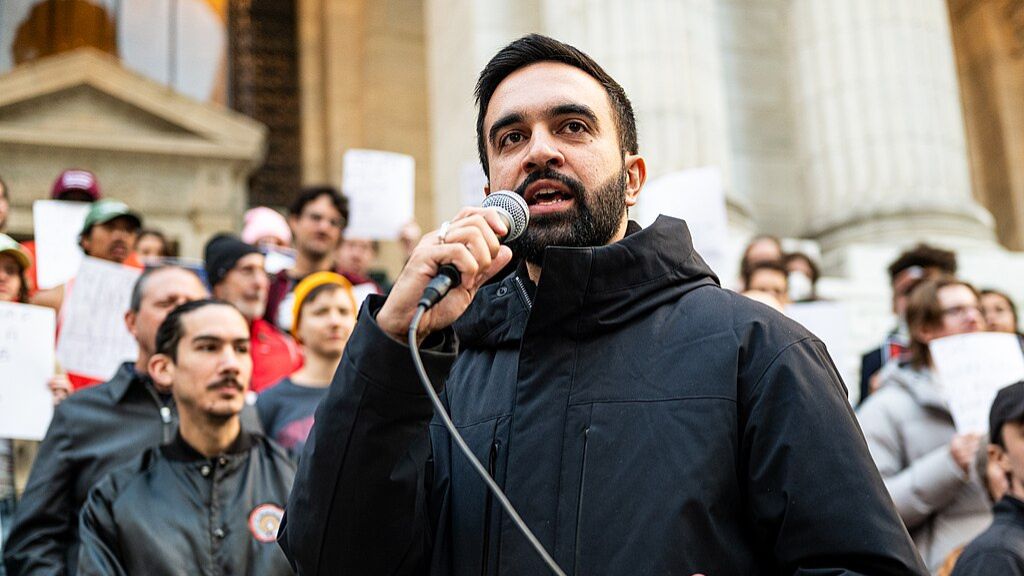
On January 3, Zohran Mamdani, the mayor of New York City, stated that he personally called President Donald Trump to express disapproval of a U.S. military strike in Venezuela that resulted in the capture of Venezuelan President Nicolás Maduro. Mamdani, a Democrat and former state legislator who became mayor of New York on January 1, referred to the operation as “an act of war”. He claimed to have informed Trump that the large-scale early-morning strike on Caracas violated both international and U.S. law during a press appearance in Brooklyn. Mamdani stated, “I called the president and spoke with him directly to register my opposition to this act,” citing his opposition to “violation of federal, international law” and “pursuit of regime change.”
Following President Trump’s announcement that American forces had conducted a “large-scale strike” in Venezuela, arresting Maduro and his wife, Cilia Flores, and transporting them to New York, Mamdani made his remarks. Trump declared that until a “safe, proper, and judicious” transfer could take place, the United States would “run” Venezuela temporarily. During his press conference, Trump claimed that U.S. military Special Forces had taken Maduro “in or near” one of his homes and struck important locations in the Caracas region, knocking out power. Maduro and his spouse were transported offshore to a U.S. Navy vessel and subsequently to New York, where they were charged with weapons and drug trafficking by prosecutors.
Mamdani, a progressive Democrat and the first Muslim mayor of New York City, claimed to have been informed of the operation and its aftermath. He underlined that the strikes “directly impact” the community of many Venezuelan-Americans who reside in New York City. He told reporters that “unilaterally attacking a sovereign nation is an act of war and a violation of federal and international law” and that it would “directly impact New Yorkers, including tens of thousands of Venezuelans who call this city home”. Making sure the U.S. plans for Maduro would have “minimal impact on the day to day lives of New Yorkers” was his first goal, he stated.
Background – U.S.-Venezuela tensions.
Caracas and Washington have a long history of antagonistic relations. The United States has supported opposition leader Juan Guaidó as interim president since 2019 and never acknowledged Maduro’s 2018 reelection as genuine. Multiple rounds of sanctions were imposed on Venezuela by the Trump administration, and Maduro was frequently threatened with military action unless he resigned. Although narcotics shipments purportedly connected to Venezuela have been captured by U.S. personnel in recent months, the nocturnal attack on January 3 was much more significant. It was the most blatant U.S. action in Latin America since the invasion of Panama in 1989, according to analysts. Attorney General Pam Bondi and other U.S. authorities have insisted that Maduro’s abduction was a law enforcement operation, citing indictments against him, while others claim it was obviously intended to impose regime change.
As part of a long-planned effort to remove Maduro, Trump declared the strike. During his news conference, he stated that American oil companies would relocate to Venezuela to repair the country’s energy infrastructure and did not rule out sending American military there. Maduro is “the newest person to find out that President Trump means what he says,” according to Trump, who has labeled the Venezuelan government as narco-terrorists. According to reports, U.S. soldiers captured Maduro by using special operations teams and pinpoint strikes on military installations. According to the United States, Maduro was apprehended without violence and is currently in American custody. Trump has not publicly commented on Mamdani’s outreach, and neither the White House nor Mamdani have disclosed the outcome of their phone conversation.
Political and legal questions.
The operation has caused a rift in American opinion at home. It was applauded by numerous Republican figures for upholding American law against a “narco-terrorist” leader. The action has drawn harsh criticism from several Democrats and legal experts, who have questioned its constitutionality and called it an unlawful use of military force. A Democratic member of the House Foreign Affairs Committee, for instance, cautioned that without congressional consent, there may be “open-ended conflict” in the area. Concern has even been voiced by American allies. Despite his personal belief that Maduro is illegitimate, British Prime Minister Keir Starmer stated that he respects international law and would pursue a peaceful transition.
Vice President Delcy Rodríguez condemned the strike as a “kidnapping” of the lawfully elected president of Venezuela. She proclaimed Maduro “the only president of Venezuela” and called for his quick release on national television. A Venezuelan court named Rodríguez acting president after she and other loyalist officials resisted American influence. The opposition groups in Venezuela, meantime, have cautiously hailed Maduro’s removal while pointing out that they are powerless and that American forces are not authorized to rule the nation.
Regional and global reaction.
The response from throughout the world has been prompt and primarily critical. The governments of Latin America denounced what they described as a breach of sovereignty. The U.S. strikes “cross an unacceptable line” and “represent a grave affront to Venezuela’s sovereignty,” according to Brazilian President Luiz Inácio Lula da Silva. Similar to this, Uruguay’s foreign ministry called for adherence to the UN Charter and “rejects military intervention by one country in the territory of another.” The government of Chile called for a peaceful resolution and “express[ed] concern and condemnation of the military actions”.
Gustavo Petro, the president of Colombia and the person in charge of Venezuela, expressed his “deep concern” over the escalation.
Guatemala, a neighbor of the United States, expressed concern. A number of nations, like as Colombia, Brazil, and Peru, have called for Venezuela to adhere to constitutional norms; some have even called for Edmundo González, a candidate whose 2024 election appearance was contested, to spearhead a transition rather than U.S. forces. Colombia has asked the UN Security Council to convene an emergency meeting to discuss the situation, with backing from China and Russia.
The precedent alarmed allies outside of Latin America.
Any resolution must “respect international law and the UN Charter,” according to the European Commission. While highlighting its right to defend against dangers like drug trafficking, the Italian government reaffirmed that “external military action is not the way to end totalitarian regimes.” Norway, a U.S. ally, emphasized that the intervention “is not in accordance with international law” and called for a “peaceful transition” in Venezuela. Analysts caution that other nations may exploit Trump’s actions. For instance, China may use it to justify pressure on Taiwan, or Russia may use it to defend its activities in Ukraine. Similar to last year’s attacks on Iran’s nuclear facilities, one analyst pointed out that the strike might cause public opinion in ally nations to vacillate between severe legal concern and grudging approval.
Implications:
Washington has now embarked on the difficult responsibility of controlling Venezuela, experts warn. U.S. “regime change” initiatives in the past, such as those in Iran, Vietnam, Iraq, and other countries, frequently proved drawn out and difficult. With ambiguous objectives, a narrow congressional mandate, and no obvious successor in Caracas, Trump’s administration is now tasked with managing a foreign transition, according to Chatham House analysts. If more military operations take place, Congress will probably face domestic pressure to use its war powers. According to the president, the United States has, at the very least, taken possession of Venezuelan territory and detained the country’s leader. Trump’s promise to cease “endless wars” will be put to the test, and it might change how the UnIted States engages with Latin America.
Mamdani concentrated on regional issues in his own comments. According to him, New York officials will keep an eye on the issue to safeguard public safety, particularly that of Venezuelan-Americans, and make sure that any consequences from the federal action are kept to a minimum. His unprecedented action a municipal mayor openly criticizing a president of his own party highlights how the intervention in Venezuela has become into a contentious and widely followed global event. It highlights the conflict between national foreign policy goals and local populations’ worries overseas, and it is unclear if Trump will respond to requests (like Mamdani’s) to reverse a course that many now view as a risky escalation.