

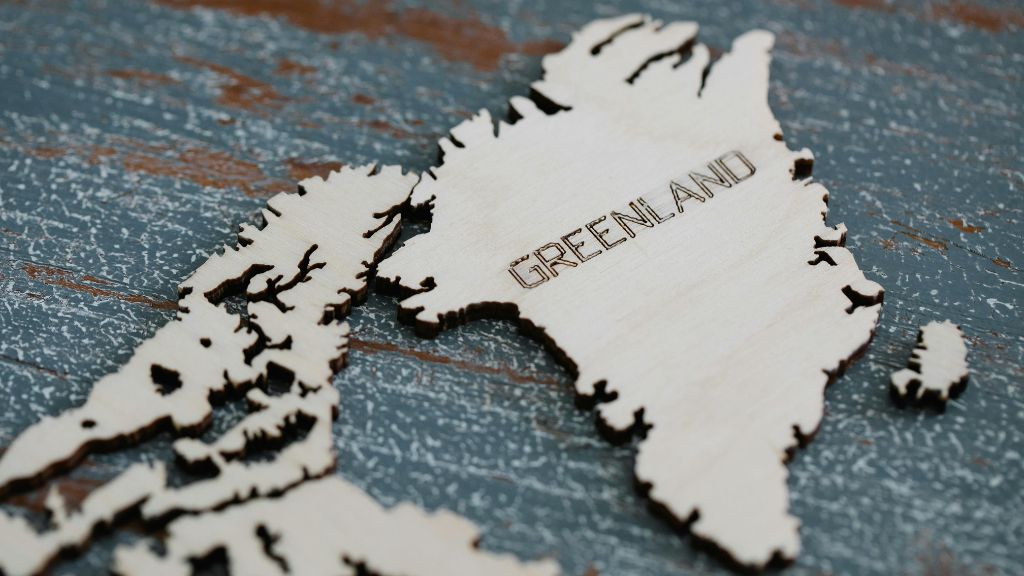
About 57,000 people live in Greenland, a semi-autonomous Arctic region of the Kingdom of Denmark. Although it is a part of Denmark’s NATO membership, it is not an independent nation. It has enormous geopolitical relevance due to its position and large land mass. Greenland is located on vital polar routes connecting Europe, North America, and Russia, and it is home to a portion of the U.S. ballistic missile warning network. Additionally, it has substantial rare-earth and mineral reserves that have attracted attention from all over the world. Greenland has long been more than just a remote island due to a number of causes, including defense facilities, new Arctic shipping channels, and abundant natural resources.
Danish government rejects U.S. overtures
When US President Donald Trump rekindled interest in Greenland at the beginning of January 2026, the topic erupted. Trump stated in an interview that “we do need Greenland for defense,” and the administration designated a U.S. envoy to develop relations. In response, Mette Frederiksen, the prime minister of Denmark, vehemently rejected any notion of an American takeover.
“Denmark has made it very clear where the Kingdom of Denmark stands, and Greenland has repeatedly said that it does not want to be part of the United States,”
she said, adding that she thinks the U.S. president “should be taken seriously” on this matter. “If the United States attacks another NATO country, everything stops,” Frederiksen stated, cautioning that an attack on Greenland would violate NATO’s tenets and ruin “80 years of transatlantic security links.” The recent appointment of a U.S. special envoy to Greenland has also drawn criticism from the Danish government, which stated that such pressure on a NATO partner was undesirable.
Greenland’s response
The municipal authorities of Greenland also disapproved of Trump’s remarks. Greenlanders have “no more fear of an imminent American takeover,” according to Prime Minister Jens-Frederik Nielsen, who also emphasized that Greenland is a democratic nation that is not like Venezuela. He pointed out that Greenland seeks closer ties with the United States, but only through respect and the rule of law. On social media Nielsen boldly told President Trump: “Enough is enough… No more annexation dreams. In conclusion, both Copenhagen and Nuuk made it abundantly evident that Greenland’s destiny will be determined by its citizens and their elected governments, not by an outside force.
European allies defend Greenland’s sovereignty
The main powers of Europe quickly united in support of Greenland and Denmark. Pascal Confavreux, a spokesman for the French foreign ministry, told viewers that “borders cannot be changed by force” and expressed France’s “solidarity” with Denmark. The destiny of the territory could only be decided by “Greenland and the Kingdom of Denmark,” according to British Prime Minister Keir Starmer. German authorities also expressed support, pointing out that Denmark’s NATO membership already includes Greenland’s security, and Foreign Minister Johann Wadephul proposed elevating Greenland’s defense at NATO [16]. Additionally, the European Union reaffirmed its long-standing stance on sovereignty. The geographical integrity of the Kingdom of Denmark, including Greenland, “must be preserved,” according to anEU spokesman, and EU ambassadors reiterated the idea that all partners should respect national sovereignty. To put it briefly, governments throughout Europe, from Western capitals to Scandinavia, denounced any attempt to change Greenland’s status without permission, stating unequivocally that Denmark and its own citizens will choose the island’s future.
Geopolitical context
Many allies were uncomfortable with the larger U.S. initiatives that preceded these events. Following a U.S. military action in Venezuela, Trump’s comments caused Europeans to fear that Greenland would be targeted next. The episode highlights Greenland’s strategic location, which includes a vital U.S. air base and the shortest missile paths between North America and Russia. Interest in Greenland has also increased due to its minerals, which include rare earth elements that are essential for technology. Western authorities point out that even close allies must uphold alliance commitments and international law: an attack on Greenland, a NATO ally, would trigger Article 5 and terminate normal relations.
All things considered, every significant European leader and spokesperson for the alliance stressed that Greenland’s sovereignty cannot be compromised. Any change in Greenland’s status must be chosen by Greenlanders and Denmark, not imposed by foreign forces, as the Danish and Greenlandic governments reaffirmed. The strong opposition demonstrates how seriously Europe views the stability of the transatlantic alliance and the idea of national sovereignty in Arctic matters