



On 24 April 2026, OpenAI unveiled OpenAI GPT-5.5, its latest and most advanced model. DeepSeek, the Chinese AI startup, released its DeepSeek V4 Pro model to the global commons less than 24 hours later. The same weekend saw both launches, setting the stage for the next era of technological competition in the AI economy.
This is no longer a competition between chatbots. It never really was. OpenAI’s relentless premium intelligence empire and DeepSeek’s cost-efficient challenger have to define the economic logic of the North America AI race. Moreover, to hold leverage over the companies, governments, and defense architectures that will build on top of it, reshaping the U.S. vs China AI competition.
If you run a business or work in tech or policy in the U.S., you can feel the pressure. The choices we make next will determine:
- How we use software, how well we protect our country’s information,
- If American startups can stay as advanced, AI will become incredibly affordable.
For years, we assumed American technology would always be a step ahead, as long as you could pay for it. That belief is about to be tested.
The day that DeepSeek comes out on Huawei first, that is a horrible outcome for our nation. NVIDIA CEO Jensen Huang, April 2026
OpenAI’s Premium Intelligence Empire
For OpenAI to defend, understanding how OpenAI GPT-5.5 embeds itself into the operating architecture of the modern enterprise AI. GPT-5.5, released 23 April, is not simply a more capable model. It is the foundation of what OpenAI president Greg Brockman calls a super app in the AI economy.
A unified computing environment merging ChatGPT, the Codex agentic coding assistant, and the Atlas browser agent into a single session. They are capable of planning, executing, and directing complex multi-step work without constant human supervision.
GPT-5.5 impressed a lot of people by hitting 55.6% on the SWE-Bench Pro coding test, which covers four programming languages. Even though it’s quicker and uses fewer tokens to get the job done, it doesn’t cost more to run. Some companies say they’re saving an hour every day. Moreover, heavy users claim they’re getting back ten hours each week thanks to the new platform.
What GPT-5.5 most concretely represents is OpenAI’s pivot from intelligence-as-a-service toward intelligence-as-infrastructure. The designers built the model to handle productivity tools and turn abstract instructions into completed tasks. For the Fortune 500, this is not a productivity upgrade. It is a structural change in how knowledge workers perform their tasks.
The enterprise trust moat is equally significant. OpenAI has built deep integrations with Microsoft Azure. Salesforce, Box, Shopify, and dozens of other platforms through its API ecosystem. Its compliance architecture, SOC 2, HIPAA readiness, U.S. data residency, and government-grade access controls.
The central AI security gives legal, healthcare, and defense-adjacent firms a framework that no Chinese competitor can currently replicate. Most users do not see that compliance infrastructure, which forms the real enterprise moat.
Safety architecture has become a competitive differentiator in its own right. A third party conducted red-teaming for cybersecurity and biosecurity risks on GPT-5.5 before launch, a framework that corresponds to the trust requirements of U.S. government procurement. As AI increasingly touches national security infrastructure, that compliance advantage compounds.
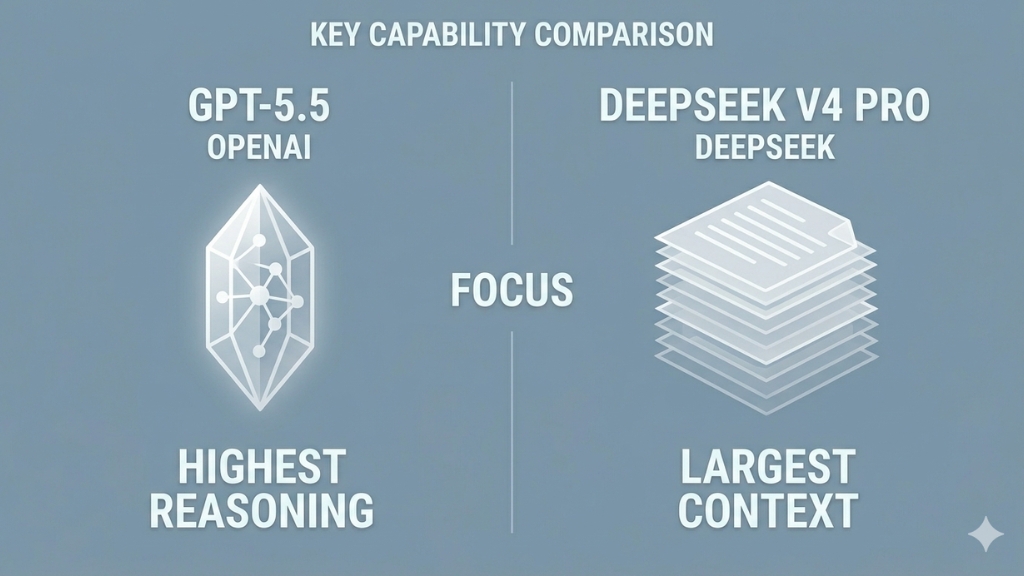
DeepSeek V4 Pro isn’t pretending to be the smartest AI on the block. The company even admits V4-Pro lags GPT-5.4 and Gemini 3.1 Pro in reasoning. Still, DeepSeek focuses on repricing the Enterprise AI landscape; sometimes, a big discount changes an industry more than a technical leap.
China’s Cost Advantage and AI Economy
The price gap is dramatic in the AI economy. DeepSeek V4-Pro charges $3.48 per million tokens; OpenAI charges $25, Anthropic charges $30. For heavy workloads, V4-Flash costs only $0.28 per million tokens. One analyst says replacing Claude with DeepSeek V4 could turn a four-month AI budget into seven years of use.
DeepSeek deliberately set its pricing ceiling lower than what OpenAI and Anthropic need to charge to cover their leading-edge training costs.
The architecture behind these prices is deliberately efficient. V4-Pro uses a Mixture-of-Experts design: 1.6 trillion total parameters, but only 49 billion active per token. The model activates only certain parts, delivering results at the cost of a 37-billion-parameter system but using the depth of a much larger one. You get top-level performance without paying premium prices.
V4 stands out from DeepSeek’s earlier models because of its hardware story. The lab gave Huawei’s Ascend 950 processors early access for optimization but denied it to Nvidia and AMD. This move shows China’s AI is separating from American chips. DeepSeek says V4-Pro prices will fall as Huawei expands Ascend 950 production in late 2026. Newer Ascend chips aim to double performance.
The 2026 Stanford AI Index shows Chinese AI labs have ‘effectively closed’ the gap with leading U.S. models. This finding, from a top benchmarking effort, forces a rethink of America’s chip export strategy. After the U.S. denied DeepSeek access to Nvidia’s best chips, DeepSeek built a more efficient architecture and its own hardware. Ironically, export controls may have sped up Chinese innovation.
The Economic Battlefield Across North America
The commercial implications cascade across multiple industries. Simultaneously, disruption is not uniformly negative for U.S. interests, but it is destabilizes the business models that dominate the AI economy.
The SaaS sector faces the sharpest immediate pressure. A generation of AI-native startups built their unit economics on the assumption that inference costs would remain high enough to justify their own pricing. DeepSeek V4’s token pricing blows those assumptions apart.
Moreover, A startup charging $50 per seat for an AI tool, while spending $30 in costs, faces a crisis if a competitor uses DeepSeek V4 Pro for $3.50. The AI software industry is about to reprice itself, challenging the foundation of U.S. innovation. Companies that don’t adapt won’t survive.
However, for large enterprises evaluating AI vendors, the decision matrix has become genuinely complex. Secondly, OpenAI offers premium intelligence, deep enterprise integrations, compliance systems, and U.S. data sovereignty. Healthcare systems and defense contractors can’t realistically use DeepSeek. But a global manufacturer or e-commerce platform might try self-hosted V4 for non-sensitive tasks.
Tech giants like Microsoft, Google, and Amazon are rethinking their huge investments in AI data centers. DeepSeek’s price pressure is making everyone reconsider costs. These companies bet billions that advanced AI would always be expensive. But as open-source models like DeepSeek push prices down, those bets might fail. The real battle is between American hardware and Chinese hardware: Nvidia chips have powered top AI, but DeepSeek’s V4, trained on Huawei’s processors, is challenging that now.
Price cannot Bridge Security, Sovereignty, and the Trust Divide
DeepSeek’s economic disturbance, the AI security analysis points in a single, unambiguous direction: no American government agency, defense contractor, or regulated financial institution can currently justify deploying DeepSeek in any sensitive capacity. The reasons go deeper than politics.
DeepSeek’s own data protection policy acknowledges that user data may be stored on servers in the People’s Republic of China.
Under China’s 2017 National Intelligence Law, organizations must support, assist, and cooperate with national intelligence efforts on demand. The legal setup guarantees that any organization using DeepSeek’s cloud API will expose its data to the Chinese state.
The Pentagon, NASA, the U.S. Navy, and the Department of Commerce have all banned DeepSeek on government devices. New York, Texas, Tennessee, and Virginia enacted state-level bans on government devices. Australia, Taiwan, Italy, South Korea, the Czech Republic, and the Netherlands all chose to restrict DeepSeek in different ways.
The House Select Committee on Geostrategic Competition characterized DeepSeek as a “profound threat” to national security, citing data harvesting architecture, connections to PRC-affiliated military research entities, and evidence of model distillation from U.S. AI systems using fraudulently obtained access.
The jurisdictional gap between U.S. and Chinese AI is the most durable competitive moat OpenAI possesses, and no pricing strategy can close it for regulated industries.
Cybersecurity firm Feroot Security discovered hardcoded links in DeepSeek’s web platform connecting to China Mobile’s authentication registry. Congressional analysts compared the risk profile against TikTok. Still, they described it as significantly more dangerous given the nature of the data flowing through AI systems: strategic planning documents, legal analysis, financial modeling, proprietary code. These are not social media interactions. They are the operational nervous system of American enterprise.
For OpenAI, this security divide is the most structurally durable competitive advantage it holds, not its model capabilities, which DeepSeek is actively narrowing, but its operating jurisdiction. U.S. data residency, court-ordered-only data access, GDPR-compatible European operations, and active engagement with defense and intelligence community procurement processes constitute a compliance moat that cannot be replicated by a Chinese lab regardless of how much it invests in engineering.
Enterprise Adoption and the Infrastructure of Applied Intelligence
The enterprise AI market in 2026 is not a single market. It is a layered ecosystem of decisions made at different risk tolerances, regulatory contexts, and operational scales, and DeepSeek and OpenAI are competing for different layers of it simultaneously.
At the regulated layer, healthcare, finance, defense, legal, OpenAI is essentially competing against itself and Anthropic. The compliance requirements, data residency constraints, and audit trail demands of these industries create a natural containment zone around U.S. AI providers.
At the open layer, developer ecosystems, AI research, global startups, cost-sensitive enterprise workflows, DeepSeek V4 Pro open weights, and aggressive pricing create a genuine competitive threat. V4’s MIT license means any developer can download the model, run it on private infrastructure, and deploy it without sending a single token to DeepSeek’s cloud API.
Moreover, Self-hosted deployment eliminates the jurisdictional data risk, leaving only the question of what is in the model’s training process, a legitimate concern given the congressional report’s findings on distillation and data provenance.
The talent and ecosystem dimension may matter as much as pricing. OpenAI has built the most extensive developer ecosystem in the industry: a marketplace of custom GPTs, a Codex platform for autonomous engineering workflows, API integrations across every major cloud and enterprise software platform, and a consumer user base of hundreds of millions.
Furthermore, an ecosystem creates network effects that pure price competition cannot easily dissolve. Developers build upon platforms where other developers build. Enterprises integrate tools that integrate with other tools. DeepSeek’s open-source credentials appeal to researchers and infrastructure-minded engineers. Still, OpenAI’s enterprise ecosystem embeds it in the operational structure of American business in ways that switching costs make it formidably difficult to dislodge.
Can America Stay Ahead If Intelligence Gets Cheaper?
The most contested strategic question in the AI economy and U.S. innovation is not who builds the best model. It is what happens to American technological leverage when frontier AI becomes cheap enough that the premium for American intelligence narrows to compliance and trust, rather than raw capability.
Two scenarios are possible. In the first, cheaper intelligence expands American economic power. If DeepSeek’s efficiency breakthroughs flow into the wider industry, forcing OpenAI, Anthropic, and Google to compete on efficiency as well as capability, the total economic value generated by AI deployment in North America increases dramatically.
So, the productivity gains of the AI transition accelerate, and the U.S., which still leads in enterprise software, cloud infrastructure, and developer ecosystems, captures a disproportionate share of the value.
Also, if Huawei’s Ascend chips continue to advance, and the trajectory from the 950 to the 960 and 970 generations suggests they will, China will have demonstrated a credible, self-sustaining AI hardware ecosystem.
Especially, the U.S. chip export control strategy was always a bet that denying China access to advanced silicon would maintain a capability ceiling. DeepSeek’s V4, trained on Huawei chips and priced below anything the American ecosystem can sustainably match, is an immediate empirical test of that bet. The evidence so far is not encouraging.
The U.S. policy response will be decisive. A regulatory system that treats AI provenance, the supply chain integrity of training data, model weights, and infrastructure, as a national security matter could formalize OpenAI’s jurisdictional advantage and create enforceable barriers to DeepSeek adoption in sensitive sectors.
An innovation policy that adequately funds frontier research, supports domestic AI hardware development, and preserves open talent pipelines could ensure that America’s lead within foundational model capability does not erode as efficiency economics flatten the cost curve. Neither is guaranteed. Both are necessary.
Dominance, Coexistence, or Fragmentation
It is unlikely to be a single winner in the AI race of 2026. Instead, the world is poised to split in two: U.S. vs China AI competition.
For American enterprise leaders, the key imperative is clarity about which layer of this economy they operate in. If your workflows touch regulated data, national security-adjacent intelligence, or proprietary information that you cannot afford to expose.
DeepSeek’s pricing is irrelevant; the compliance cost and reputational risk make it non-viable regardless of token economics. If your AI workloads are commodity inference on non-sensitive data, you have genuine optionality, and ignoring it is a fiduciary failure.
For decision-makers, the lesson of DeepSeek V4 Pro is that chip export controls, while necessary, are not sufficient. A strategy that combines hardware restrictions with AI provenance standards, domestic semiconductor investment, research funding, and talent retention is the only framework robust enough to maintain a meaningful American advantage in a context in which Chinese AI efficiency has crossed the threshold of competitive relevance.
OpenAI’s enterprise AI system is still at the top, but it can’t just coast on its reputation anymore. Now, when they ask for premium prices, they actually have to prove to finance chiefs and lawyers that it’s worth it. That’s a tougher spot to be in, but it may be a fairer one for everyone.
The next era of AI will not be won by whoever builds the smartest model. It will be won by whoever builds the most trusted infrastructure, and trust, unlike intelligence, cannot be distilled, open-sourced, or priced into obsolescence.